Mid-century motel architecture in Cocoa Beach: what's left of the Cocoa Beach Modern
A field survey of the surviving mid-century-modern motel architecture in Cocoa Beach. Cinder block, jalousie windows, kidney pools, and neon. What was the Cocoa Beach Modern style, where you can still see it, and what's been demolished.
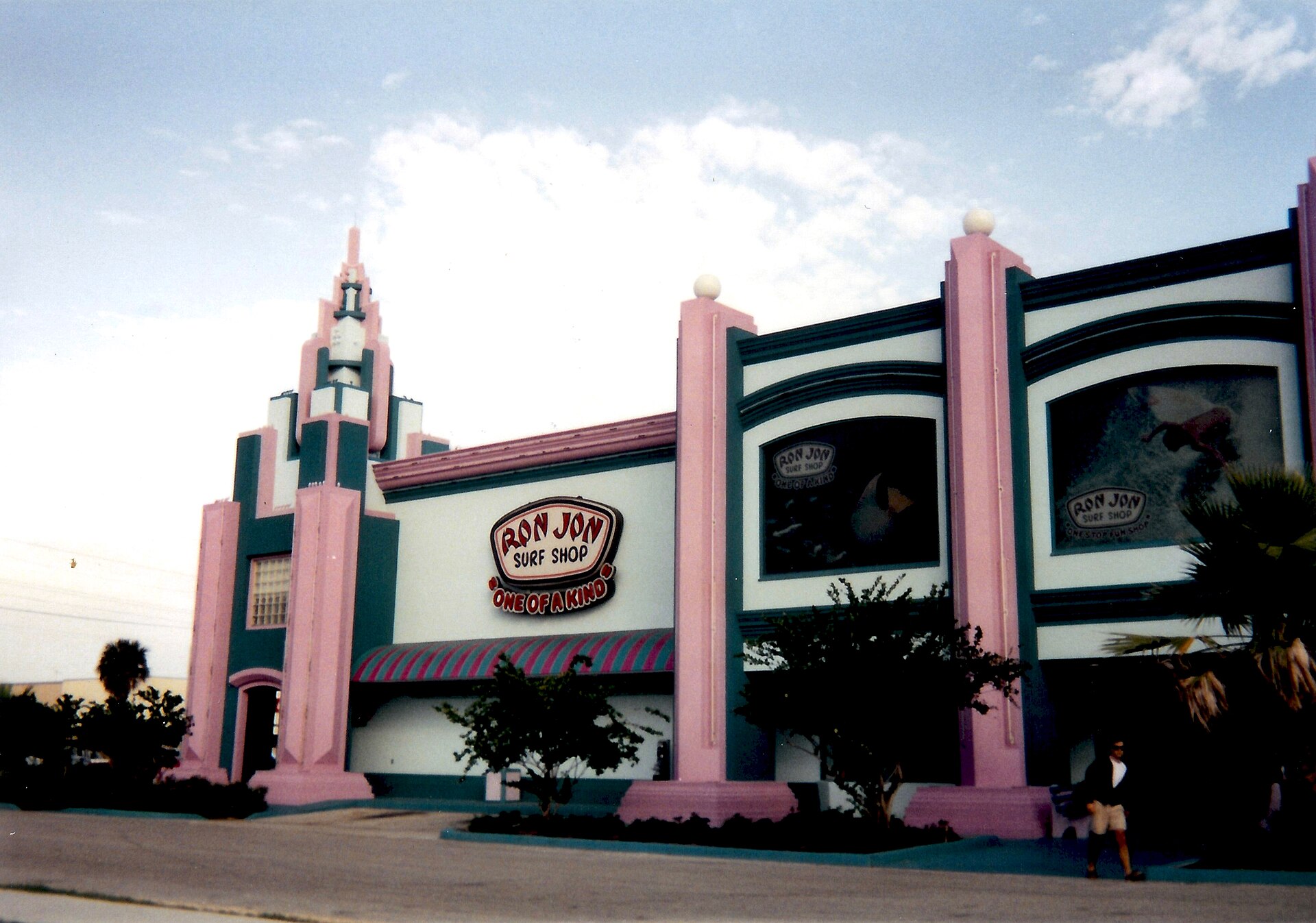
The “Cocoa Beach Modern” isn’t a recognized architectural style in academic publication. There’s no monograph, no Florida Trust survey volume, no preservation-easement program. What it is, in practice, is a regional vernacular: the construction shorthand that built dozens of mid-sized tourist motels along Cocoa Beach’s A1A and side streets between roughly 1958 and 1972, in response to the contractor and tourist economy generated by the missile-and-Apollo program. It produced a distinctive visual signature, cinder-block walls, jalousie windows, kidney-shaped swimming pools facing the parking lot, exterior-corridor floor plans, atomic-and-rocket-themed neon signage, that defined how the town looked for the second half of the 20th century.
By 2026, most of it is gone. Demolitions through the 1990s and 2000s erased the majority of the original motel stock, replaced by condominium developments and modern hotel chains. What survives is scattered, often modified, and rarely protected. This is the field survey.
The style, defined
Cocoa Beach mid-century motel vernacular has six elements:
-
Cinder-block construction. Concrete masonry units (CMU), stuccoed on the exterior. Cheap, fast, hurricane-resistant in modest storm conditions, hot but workable with the air conditioning that became standard in the 1960s.
-
Exterior-corridor floor plan. Rooms open to a covered exterior walkway rather than an interior hallway. Lower construction cost; passive ventilation; the now-distinctive look of motel doors lined up along a balcony rail.
-
Jalousie windows. Horizontal slatted glass operated by a single crank. Provide ventilation and modest privacy. Common across mid-century Florida; almost universal in Cocoa Beach motel construction of the era.
-
Kidney-shaped or rectangular swimming pool. A standard amenity. The kidney shape was the higher-end variant; many smaller motels had rectangular pools. Pool placement was usually courtyard or parking-lot-adjacent, visible from the street to advertise the amenity.
-
Atomic/missile/rocket neon signage. This is the most photogenic feature. Sign names referenced the space program: Polaris, Vanguard, Sky-Lab, Sea Missile, Astro, Surf, Cape Colony, Holiday. Sign typography was period-correct mid-century, often using stylized rocket forms or starbursts. Neon (or in later years, fluorescent) lighting made the signs nighttime landmarks along A1A.
-
One- to two-story massing. Construction stayed low, Cocoa Beach building codes and the economics of mid-century motel construction both favored compact two-story buildings over taller structures. The condominium-tower era that arrived in the 1980s and 1990s changed this.
Combined, the Cocoa Beach Modern motel looked like cousins of Miami Beach’s MiMo (Miami Modern) architecture but at a smaller scale and without the larger budget. It was working-class regional vernacular, adapted from Miami Beach influences, simplified for Brevard County construction budgets, oriented around the missile-and-rocket symbolism that defined the town’s identity.
The peak inventory, 1970
By 1970, Cocoa Beach had something like 40 to 60 distinct motels along A1A and the immediately-adjacent side streets, in the mid-century-modern vernacular described above. Population that year was 9,952 residents; transient population during launch events and tourist season pushed the demand past 20,000 in peak periods. The motel inventory absorbed that demand.
The most prominent properties at peak inventory:
- The Holiday Inn, on A1A in central Cocoa Beach, run by Henri Landwirth (the unofficial astronaut headquarters during Mercury). Subsequently demolished.
- The Cape Colony Inn, on the north end of the strip. Demolished.
- The Polaris, central Cocoa Beach. Demolished.
- The Vanguard, near the pier. Demolished.
- The Sea Missile, central A1A. Demolished.
- The Sky-Lab, south Cocoa Beach. Demolished.
You see the pattern. The most iconic, most-photographed motels, the ones that appeared in Apollo-era Life magazine spreads and in Florida tourism marketing, are mostly gone. The condominium-redevelopment cycle of the 1980s through 2000s took them.
What survives, 2026
A partial inventory of surviving Cocoa Beach mid-century motels, recognizable in 2026 form:
-
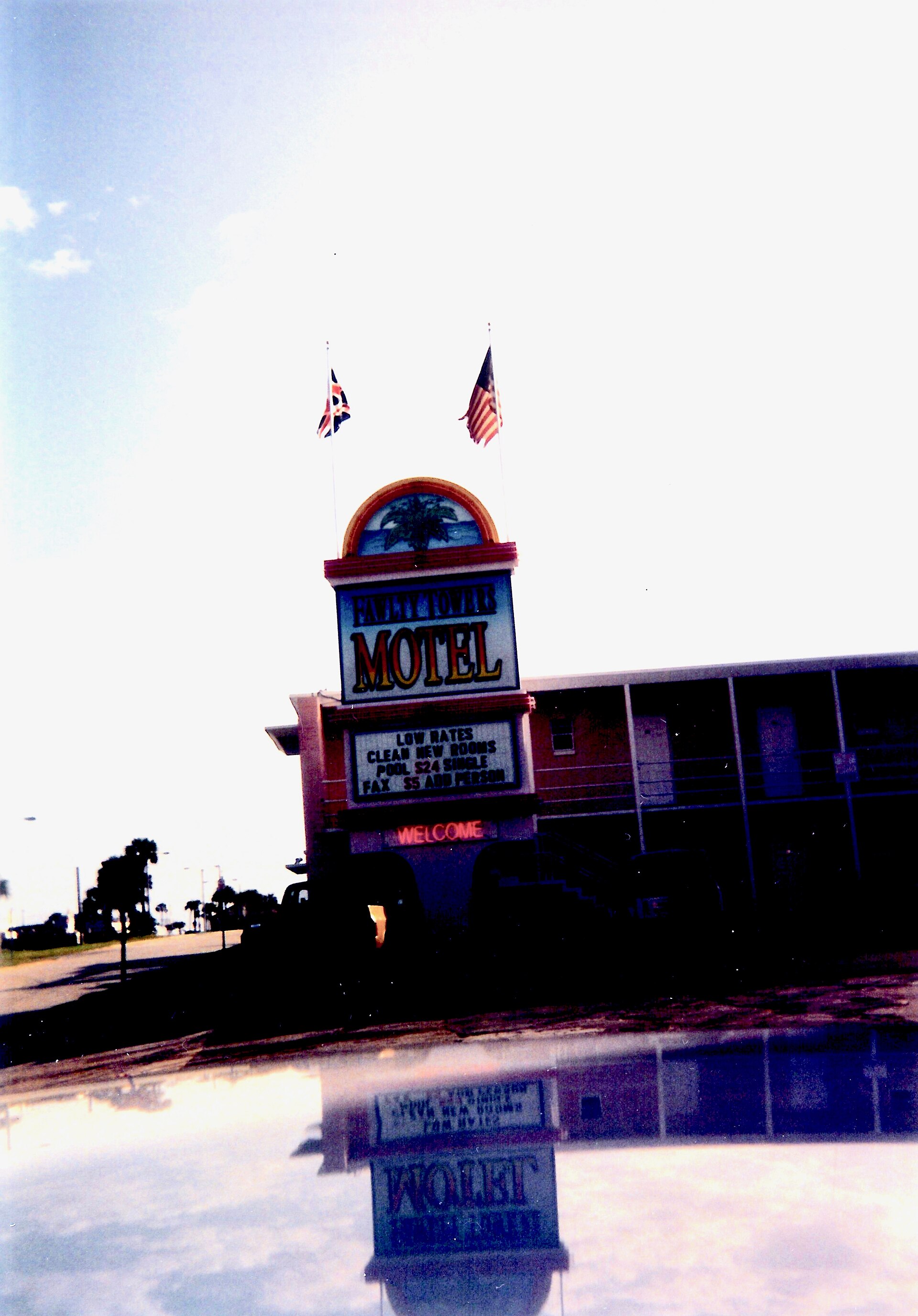
Fawlty Towers Motel (still operating in some form). The Phillip Pessar 1991 photographic series captured this property at its mid-1990s appearance; the building has been modified since but the original mid-century bones remain.
-
The Surf Inn, the Cocoa Beach Suites, the Cocoa Beach Sun, and a handful of similar smaller properties. Often updated paint, signage, and finishes; original cinder-block walls and jalousie or partially-replaced window glazing.
-
Several A1A motel courtyards between the pier and the south boundary. Identifying these by name is a moving target because of frequent ownership changes; they’re recognizable visually by the criteria above.
What’s missing from the surviving stock: the larger, more elaborate properties (the original Holiday Inn-class structures, the Vanguard-class properties). Those didn’t survive the condominium-redevelopment cycle. Surviving stock tends to be smaller, more modest, and less commercially valuable, which is also why it hasn’t yet been replaced.
Why the demolitions happened
Three reasons, in declining importance:
Real-estate value compression. A 50-room oceanfront motel on a half-acre Cocoa Beach parcel in 2000 had a building value of maybe $1 million and a land value of maybe $4 to $8 million. The economics of demolishing the building to build a condominium were straightforward, the condo developer paid the owner more for the land than the owner could earn operating the existing motel for the next decade. Pre-Andrew (pre-1992 Florida building code revisions) construction also faced rising insurance costs that pressured operating economics.
Aging infrastructure. By the 1990s, original 1960s-vintage mechanical systems (HVAC, plumbing, electrical, pool equipment) were 25 to 35 years old and reaching their useful-life endpoint. The capital required to fully renovate a mid-century motel to current standards was, in many cases, similar to the cost of demolition-and-redevelopment.
Tourism market evolution. The Cocoa Beach tourist mix in 2000 was different from 1970. Customers expected interior corridors, in-room amenities, branded hotel reliability. The chain hotels (Hilton, Marriott, Hampton Inn, Best Western) that arrived on A1A captured the higher-rate-paying tourist segment. The unchained mid-century motels were left with the budget tier, which couldn’t support the capital for renovation.

What might still get preserved
The 2026 landscape is not entirely hopeless for mid-century preservation. A few factors trend in the preservationists’ favor:
- Mid-century-modern architecture has gained substantial appreciation in the broader U.S. design culture since the 2000s. The same vernacular that was dismissed as “outdated 1960s” in 1990 is now valued as “authentic mid-century” in 2026.
- Florida’s heritage-tourism market has grown. Mid-century-themed accommodations, particularly with strong neon signage and pool design, can command premiums from a specific tourist segment that values authenticity over generic chain-hotel quality.
- Limited remaining inventory: with the most prominent properties already demolished, what survives has scarcity value.
That said, no formal preservation framework exists for Cocoa Beach mid-century architecture. The Florida Trust for Historic Preservation has surveyed some Cocoa Beach properties but does not maintain a designated preservation district. The City of Cocoa Beach does not currently offer property-tax incentives, easement programs, or formal designation for mid-century structures. Buildings are protected only by their owners’ decisions to maintain them.
A motel that loses its current owner to retirement, death, or sale faces immediate redevelopment risk. The condominium-developer interest in oceanfront parcels remains strong; the regulatory framework still permits the demolitions.
What you can see in 2026
For anyone interested in mid-century Cocoa Beach architecture, the recommended approach is:
-
Drive A1A from the south Cocoa Beach boundary north to the pier, then north to the Cape Canaveral boundary. Look for cinder-block construction, exterior-corridor balconies, kidney pools visible from the street, and neon signage.
-
Walk the side streets between A1A and the Atlantic, particularly the cross-streets between First Street and Twentieth Street. Some smaller mid-century motels survive in these neighborhoods.
-
Visit the Phillip Pessar 1991 photographic series online (Wikimedia Commons, Florida Memory) for comparison documentation of what was present before the demolitions.
The architecture is not protected. The next decade will see more of it gone. Whatever you see in 2026 is, increasingly, what you’re getting one last chance to see.
Further Reading
Sources
- Florida Memory Project, Phillip Pessar 1991 photographic series, via Wikimedia Commons
- Florida Trust for Historic Preservation, floridatrust.org
- City of Cocoa Beach planning and zoning records, demolition permits 1985 to 2024
- Brevard County Property Appraiser, parcel records and improvement histories
- Florida Today archives, real-estate and architecture coverage, 1985 to 2024
As an Amazon Associate we earn from qualifying purchases.